

Utility Work Zones on Your Property
Understanding rights-of-way, public utility easements, and more.
Utilities on Your Property
The availability of public utilities is often a comfort taken for granted. Whether aerial on utility poles or buried underground, water, sewer, gas, electric, and communications infrastructure support our daily activities.
As a property owner, it is important for you to understand how utilities serve your property and the surrounding community. It's also important to understand utility companies' right to work in specific utility corridors with infrastructure.
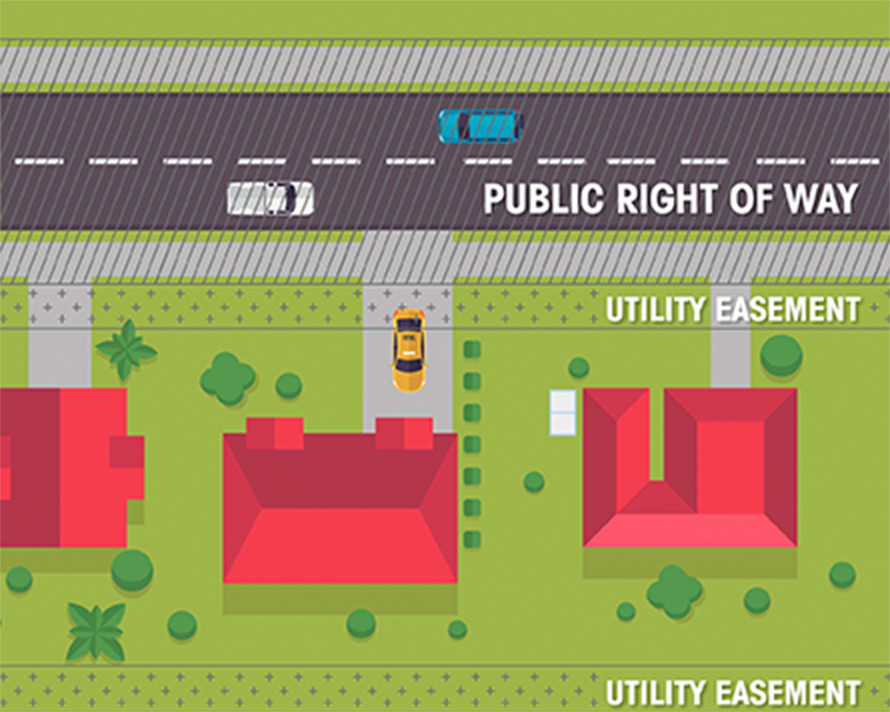
Utility providers generally have three utility corridors they can occupy:
- Public Rights-of-Way (ROW) — Publicly dedicated for roadways, utilities, landscaping, drainage, etc.
- Public Utility Easements (PUE) — Nonexclusive easement for utilities to construct, operate, and maintain infrastructure. Access to perform these functions is implied.
- Private Easements — Easements for specific utility usage - often defined in a stand-alone agreement between the utility and property owner.
Utility Corridor Information
The most common way to form ROW, PUE, and other easements in a neighborhood is through formal subdivision. Formal subdivision plats are filed with the local government. Contained in the plat are noted dedications and representations of ROW, PUE, private easements, and other specifics of the subdivision. Note that every subdivision is different. A careful review of the plat associated with your property is required to determine where ROW, PUE, etc. are dedicated.
Here is an example section from a plat, with the public utility easements area in green:
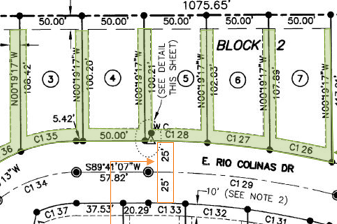
Public utility easements are sometimes only described in written notes instead of being shown on plat maps, as is demonstrated in the previous example. Here's an example of a note defining a public utility easement:

Jurisdiction and Permission
From the Federal Highway Administration to local municipal government, the jurisdiction and usage of rights-of-way, easements, and other utility corridors is a complex regulatory environment that all utility companies must navigate. Here are the general guidelines for each utility corridor:
Right of Way — The right to use and occupy the public ROW to provide utilities and other similar services is typically governed by state law and may require specific agreements with county or municipal authorities. Agencies such as the state Department of Transportation (DOT), county highway department, and municipal streets department dictate specific construction, traffic control, and restoration requirements for utilities accessing public ROW. Due to these agencies' administration of roadways and public utilities such as water and sewer in ROW corridors, utility and other similar service providers are often required to obtain permits to construct or work in the ROW.
Public Utility Easement — Jurisdiction in PUE varies from community to community. Although local governments often require subdivisions to contain PUE corridors through official codes and ordinances, they typically do not hold jurisdiction to permit the usage of said PUE. PUE is a nonexclusive easement dedicated for use by public utilities and compatible service providers expressly for the construction and distribution of their networks in that specific subdivision. It's often up to utility and similar service providers to manage these corridors.
Private Easement — Jurisdiction over a private utility easement is typically described in a stand-alone agreement between the utility and the grantor of the easement (property owner). Utility companies will likely require reasonable space to construct, operate, access, and maintain their infrastructure. Although private easements are typically between a specific utility and a property owner, they are subject to state and federal law, which may allow them to be used by other providers for compatible uses. Private easements should be recorded with the county and can only be severed through formal release.
Work on Private Property
If network construction needs to take place on private property, outside of designated public work areas, TDS secures any necessary right-of-entry and/or access approvals from property owners or community boards prior to beginning that work.
If you have questions or need help obtaining your plat, please call our construction hotline at 1-855-259-8576.
TDS Fiber Order Terms Reminder: When you order TDS fiber service you agree to be contacted by TDS with updates and when fiber service is available at your home. You also agree that TDS technicians may access your premises prior to installation to conduct a site survey and to place temporary or permanent facilities. This includes placing a buried or aerial fiber line to your home. See TDS terms and policies for more information.

Use of this website is governed by the Website Terms of Use at https://tdstelecom.com/policies/terms-of-use.html.
TDS Telecom®, TDS Metrocom®, TDS TV®, and TDS® are registered trademarks of Telephone and Data Systems, Inc. are licensed to TDS Telecommunications LLC. Other product and company names mentioned on the Site may be trademarks of those respective owners. All materials are provided for noncommercial personal use only.
TDS Telecommunications LLC is a subsidiary of Telephone and Data Systems, Inc.
Copyright © , TDS Telecommunications LLC, All Rights Reserved.